
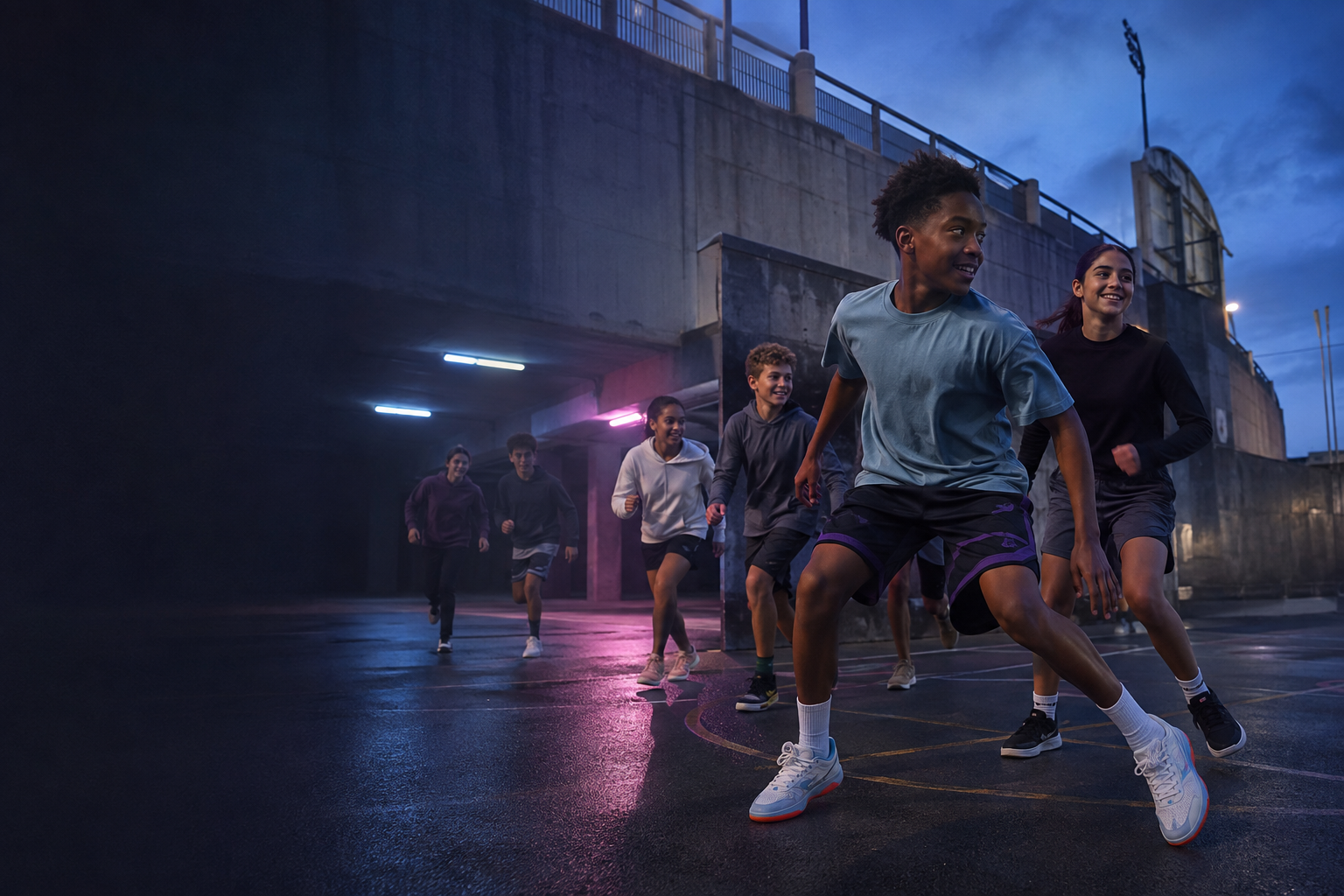
A child can know that movement is good for them and still have no reason to join in.
Health guidance explains how much activity children need. It cannot create the moment when one child calls another outside, invents a rule, assigns a role, or says, “You’re on our team.”
That moment matters. Children do not experience movement only as exercise. They experience it as play, friendship, competition, cooperation, embarrassment, confidence, exclusion, and belonging. The social setting can be part of the invitation or part of the barrier.
If we want children to move more, we should take that social reality seriously.
Activity is not only an individual decision
Public conversations about physical activity often focus on personal motivation. Children are told to make better choices, reduce sedentary time, or develop healthier habits. Those goals are reasonable, but they can place too much responsibility on the child.
The latest United States Report Card on Physical Activity gave overall youth activity a D−. It also reported disparities across racial and ethnic groups and among children with disabilities. The result is not evidence of a generation that simply refuses to move. It points to a broader system of opportunity, access, confidence, support, and design.
A 2025 systematic review and meta-analysis examined factors influencing physical activity among children and adolescents through a social-ecological model. It found consistent positive associations at several levels. Enjoyment and self-efficacy mattered. So did parental participation, peer support, and team sport. The authors also warned that higher-level influences, including schools, community facilities, policy, and the built environment, remain underexplored.
The practical lesson is simple: movement does not begin and end with willpower.
Belonging can be part of the reason to move
Research on youth sport offers a useful comparison. A 2026 systematic review covering 189 studies found that sport participation was consistently associated with better social outcomes, including belonging, prosocial behavior, and interpersonal skills. Team sports showed stronger and more consistent benefits than individual sports.
Sport is not the only answer, and it is not available or welcoming to every child. The point is that structured activity can provide more than motion. It can provide roles, rules, shared goals, feedback, identity, and a group that notices whether you arrive.
The American Academy of Pediatrics has similarly emphasized that developmentally appropriate play with parents and peers supports physical, social, emotional, and cognitive development. In play, children negotiate, cooperate, imagine, take manageable risks, and recover from disagreement. Movement becomes part of a larger human experience.
This matters at a time when social support itself is under pressure. In a 2024 report based on nearly 280,000 adolescents across Europe, Central Asia, and Canada, WHO reported declines in both family and peer support between 2018 and 2022. The data do not prove that less support causes less movement. They do show why connection should not be treated as a decorative benefit added after an activity is designed.
Connection can be part of the design.
Shared purpose is stronger than a command
“Go exercise” describes an obligation. “We need you for the mission” creates a role.
That distinction sits at the center of GameFit. We are exploring how stories, games, and characters can give children a reason to carry play into the physical world. The screen is not the destination. It sets up a mission that becomes more interesting when children interpret it together.
One child might lead. Another might solve a clue, create a boundary, keep the story moving, or adapt the rules. Running fastest should not be the only valued contribution. A strong play system gives children several credible ways to matter.
This is different from attaching points to prescribed exercise. It is also different from asking a child to perform for a tracker, leaderboard, or camera. The aim is not to disguise a workout. The aim is to make movement a natural consequence of a story children want to continue.
GameFit describes that sequence as:
WATCH — Encounter a world, character, conflict, or challenge.
PLAY — Choose roles, interpret the mission, and decide what happens next.
MOVE — Carry the shared purpose into active, real-world play.
RETURN — Bring back a memory, choice, or result that gives the next story more meaning.
The loop should work for one child with an adult, a pair of friends, a family, a club, or a larger group. Social does not have to mean public. It means the experience recognizes relationships as part of play.
Social design must also prevent exclusion
Social play can motivate, but it can also expose children to comparison, rejection, or pressure. A team can create belonging for one child and make another feel unwanted. Any serious design proposition has to account for both possibilities.
For GameFit, that means testing for more than minutes moved. We should examine who joins, who stays, who speaks, who chooses a quieter role, and who is left at the edge. We should design flexible rules, multiple forms of contribution, age-appropriate adult involvement, and ways to participate without public ranking.
It also means firm privacy boundaries. Shared play does not require public profiles, precise location tracking, biometric monitoring, or open social feeds. The system should collect as little child data as possible and keep adults responsible for the setting in which play takes place.
Inclusion is not achieved by calling an experience inclusive. It has to be visible in the choices the experience allows.
The proposition to test
GameFit’s proposition is not that every child needs organized sport or a digital prompt before moving. It is narrower and testable:
When stories give children a shared purpose, can they create more voluntary, active, and socially meaningful play?
We intend to test that question with parents, educators, youth organizations, researchers, athletes, creators, and responsible design experts. The work should examine enjoyment, participation, inclusion, repeat play, and the quality of the social experience, not only physical output.
Children may not need another instruction to move. They may need a role worth taking, a story worth continuing, and someone who wants them in the game.